
For over a decade, Search Console had one job: tell you how your website performed on Google. Your Instagram posts, your TikToks, your YouTube videos — all invisible to it. If you wanted to know whether any of that content actually showed up in Google Search, you were out of luck.
That gap just closed.
Key Takeaways
Google launched Platform Properties on 7 July 2026 — a new Search Console property type for Instagram, TikTok, X, and YouTube.
You don’t need a website to use it. Creators and businesses without a domain can now verify a social account directly.
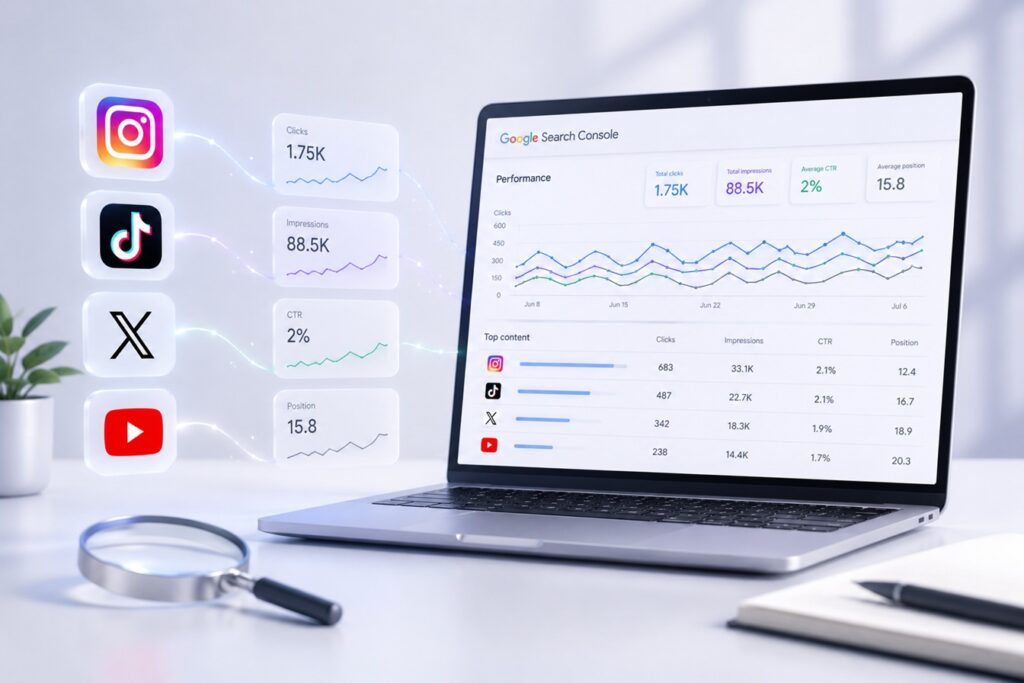
It reports on clicks, impressions, CTR, and search position for your social posts — the same metrics you already track for your site.
Facebook and LinkedIn aren’t supported yet, and rollout is gradual, so don’t panic if it hasn’t appeared in your account.
This is a measurement tool, not a ranking boost. It won’t move your website up the SERPs, but it will tell you which content and platforms are actually earning search visibility.
Official Google Announcement: platform properties social video guide
What Are Platform Properties, Exactly?
Platform Properties is a new property type inside Google Search Console, sitting alongside the website property you already use. Google’s Search Central team announced it on 7 July 2026, and it lets you connect and verify your Instagram, TikTok, X, or YouTube account to see how that content performs specifically in Google Search and Discover — not just inside the platform’s own app.
Once you’ve verified an account, Search Console generates three reports for it, built on the same data structure it already uses for websites. That means the Performance report will feel instantly familiar: clicks, impressions, average CTR, and average position, filterable by individual post and by the search query that surfaced it.
This builds on a smaller experiment Google quietly ran back in December 2025, which auto-pulled some social data into Search Console Insights. The July 2026 version is a proper standalone property — you add it yourself, it works even without a website, and it covers accounts you don’t own the domain for.
Why This Actually Matters for Small and Mid-Sized Businesses
If you’re running Google Ads or investing in SEO for an Auckland business, you’ve probably had this conversation internally: “We post on Instagram and TikTok, but does any of that actually help us get found on Google?” Until now, nobody could answer that with real data. You were guessing based on likes and follower counts, which tell you almost nothing about search intent.
Platform Properties changes that. You can now see:
- Which specific posts are surfacing in Google Search or Discover
- What search terms people typed to find them
- Whether Image, Video, Web, or News search is driving the traffic
- How that performance compares across your Instagram, TikTok, X, and YouTube accounts
For service businesses, tradies, and e-commerce brands alike, that’s the missing link between content strategy and search strategy. If a topic performs well for you on YouTube in search, that’s a strong signal to build a proper page around it on your website too — rather than letting the insight die inside a platform you don’t control.
If you want to rank up in YouTube and gain more view, read SEO for YouTube
What It Won't Do
It’s worth being clear-eyed here, because it’s easy to overhype a launch like this. Platform Properties is a measurement feature, not a ranking mechanism. Verifying your Instagram account will not push your website up the rankings. Your site’s SEO still depends entirely on your pages, your technical setup, and your content quality.
What this data does is inform decisions. It tells you which topics and formats are already earning attention in Google Search, so you can double down on what’s working — on your site and off it.
It’s also worth not confusing this with two other things Google shipped around the same time in 2026:
- The December 2025 “social channels” experiment — an earlier, more limited version that auto-detected some profiles.
- Search profiles (June 2026) — public-facing pages that showcase a creator’s content to followers. That’s audience-facing. Platform Properties is private analytics, for your eyes only.
Three separate launches, easy to mix up in the SEO press — but only Platform Properties gives you performance data.
How to Get Started
1- Log into Search Console and look for the option to add a new property type. If you don’t see it yet, don’t assume something’s broken — Google confirmed the rollout is gradual and will reach accounts over the following weeks.
2- Verify each social account you want to track. Google periodically re-checks this connection, so if a login expires, access pauses until you re-verify — no data is lost in the meantime.
3- Cross-reference with your website content. If a post performs well in Google Search, look for the gap: do you have a dedicated page on your site covering that topic in depth? If not, that’s your next piece of content.
4- Repeat across platforms. Currently supported: Instagram, TikTok, X, and YouTube. Facebook and LinkedIn are notably absent at launch, so plan your measurement strategy around the four you can actually track.
The Bigger Picture
This launch fits a pattern we’ve been tracking all year. Search Console has quietly expanded from a technical SEO tool into something closer to a full search intelligence layer — AI Overviews reporting, AI Mode impressions, branded query segmentation, and now social performance, all in one place. If you’re only checking Search Console for crawl errors and keyword rankings, you’re leaving a lot of the picture unexamined.
For businesses juggling paid ads, organic SEO, and a social presence, that consolidation is genuinely useful. It’s one less blind spot between “we post content” and “we know if it’s working.”
Frequently Asked Questions
Does Platform Properties require a website?
No. This is one of the biggest shifts here — creators and businesses without a standalone website can now verify a social account and get Search Console data for it.
Which platforms are supported?
Instagram, TikTok, X (formerly Twitter), and YouTube, as of the July 2026 launch. Facebook and LinkedIn are not yet supported.
Will this improve my website's Google rankings?
No. It measures how your social and video content performs in Google Search — it doesn’t directly influence your website’s rankings. It’s a strategic input, not a ranking factor.


