
Search used to be simple. Someone typed a question into Google, scanned a list of blue links, and clicked one. That’s the model your website was probably built for, and it’s quietly falling apart. By 2026, Gartner expects traditional search engine volume to fall by roughly a quarter as people send more questions to AI assistants instead (Gartner, 2024).
For a business that runs on Google traffic, that’s not a minor tweak. This guide explains what AI is doing to SEO, why it hits your bottom line, and the practical steps that keep customers finding you.
KEY TAKEAWAYS
- AI answers are absorbing clicks. Organic click-through rates can roughly halve when Google shows an AI Overview (Seer Interactive, 2025).
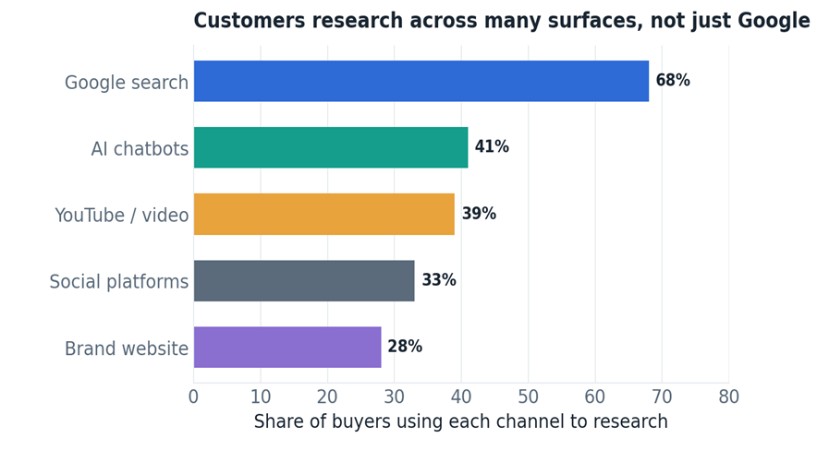
- Customers now start research inside ChatGPT, Perplexity, and Gemini, not only Google.
- The fix isn’t abandoning SEO. It’s optimizing so AI tools cite and quote your business as the trusted source.
What Does “AI in SEO” Actually Mean?
AI in SEO describes two shifts happening at once. First, search engines answer questions directly with AI, so users have fewer reasons to click. Second, marketers use AI tools to research, write, and optimize content far faster than before. As of early 2026, Google’s AI Overviews appear on a large share of informational searches (Google, 2025).
Think of it as a demand side and a supply side. On the demand side, your customers’ search habits are changing: they ask full questions and often get a complete answer without visiting any website. On the supply side, the way SEO work gets done is changing too, because a small team can now produce in a day what used to take a week.
You’ll hear new acronyms thrown around, like GEO (generative engine optimization) and AEO (answer engine optimization). Strip away the jargon and they mean one thing: making sure AI systems understand your business well enough to recommend it. That goal sits right next to classic SEO, not against it.
“AI in SEO” covers both how people search and how SEO gets done. By 2026, AI answers handle a large share of informational queries (Google, 2025), so the work shifts from earning clicks to becoming the source AI engines trust and cite.
How Are AI Overviews Changing Search Traffic?
In 2025, Seer Interactive found organic click-through rates roughly halved on queries where Google displayed an AI Overview, with position-one clicks falling from about 39% to the mid-teens (Seer Interactive, 2025). The answer sits at the top of the page, so the user’s question is already solved before they reach your link.
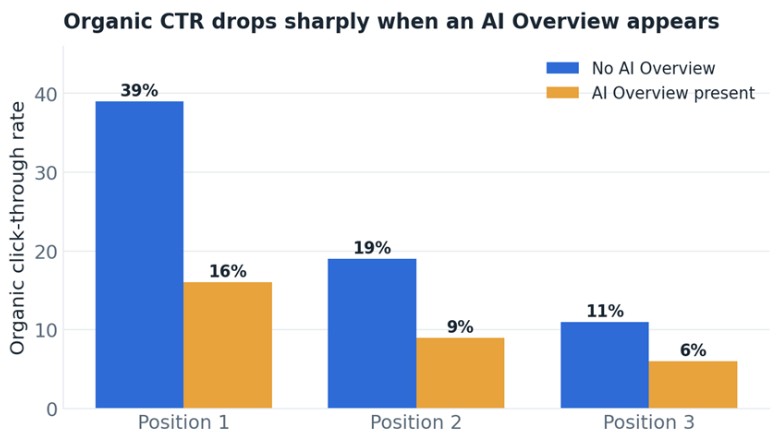
This accelerates a trend that’s been building for years: the zero-click search. Industry analyses from SparkToro have long shown that most Google searches end without anyone clicking through to a website (SparkToro, 2024). AI Overviews push that number higher because the summary answers more of the query right on the results page.
So what does this mean for you? Informational keywords that once drove steady traffic may now convert into views without visits. The smart response is to track which of your pages serve quick answers versus deeper intent, and protect the pages that still earn clicks and customers.
Why Are Customers Starting Their Search in AI Chatbots?
By late 2025, ChatGPT reported well over 800 million weekly users, and rivals like Perplexity and Google’s Gemini kept growing alongside it (OpenAI, 2025). A meaningful slice of your customers now ask an AI assistant first, the way they used to open a search box.
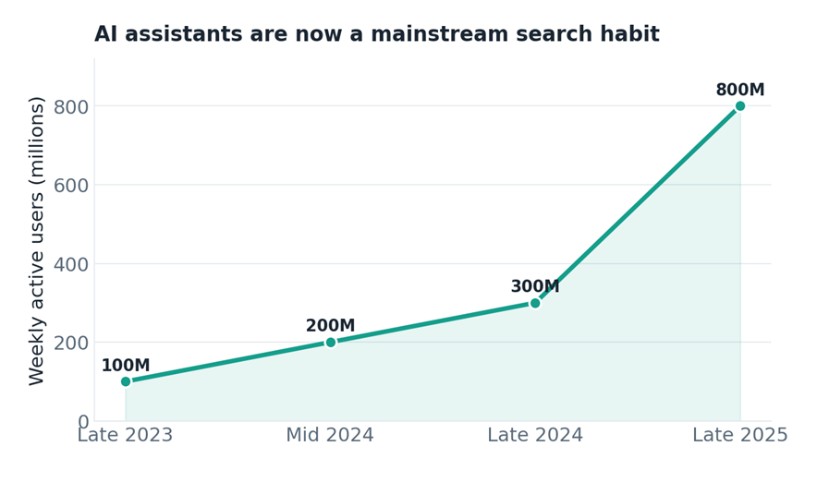
Why the shift? An assistant gives one synthesized answer instead of ten links to sift through. It remembers context, compares options, and even drafts the email afterward. For a busy person comparing vendors or products, that’s simply less work.
Here’s the part many owners miss: AI assistants don’t send a ranked list, they make a recommendation. Ranking tenth on Google still gets some clicks. Being left out of an AI’s shortlist gets you nothing. Visibility is becoming closer to all-or-nothing, which raises the stakes on being the cited source..
That changes the question you should ask. It’s no longer only “where do I rank?” It’s “when someone asks an AI about my category, does my business come up at all?”
How Should Businesses Adapt Their SEO Strategy?
Adapting means optimizing to be the source AI engines quote, not just the link Google ranks. Research from BrightEdge and others suggests brands cited inside AI answers earn outsized trust and visibility (BrightEdge, 2025). The good news: most of the work overlaps with SEO fundamentals you may already have.
Five moves that matter most:
- Build topical authority. Cover your subject thoroughly so engines see you as an expert, not a one-page afterthought.
- Add structured data. Schema markup helps AI parse your prices, hours, reviews, and FAQs accurately.
- Write answer-first content. Lead each page with a clear, quotable answer in the first 40–60 words so AI can extract it.
- Earn brand mentions. AI models weigh what others say about you across the web, so press, directories, and reviews count.
- Keep your basics clean. Fast pages, clear headings, and accurate business info still decide whether you get included
What SEO Tasks Can AI Tools Handle for You?
Plenty, and that’s where small teams gain ground. Surveys from HubSpot show a large majority of marketers now use AI in content workflows to save hours each week (HubSpot, 2025). Used well, AI removes grunt work so your people focus on judgment and brand voice.
Tasks AI handles reliably today include keyword research and clustering, drafting outlines and first drafts, writing meta titles and descriptions, suggesting internal links, and turning one article into social posts. Each used to eat real hours.
A word of caution: Google rewards helpful, people-first content and has repeatedly cleared out thin, mass-produced pages. AI drafts without human review tend to read as generic and can quietly hurt you. Keep a person in the loop for facts, experience, and voice. Your real-world expertise, the E-E-A-T signals, is exactly what AI can’t fake.
Is Traditional SEO Dead?
No, but it’s changing shape. Even with AI answers everywhere, Google still handles billions of searches a day, and those clicks still convert (Google, 2025). What’s fading is the assumption that a top-ten ranking automatically delivers traffic and sales.
Think of it as search-everywhere optimization. Your job is to be present and trusted across Google, AI assistants, YouTube, and the communities where your customers actually ask questions.
The fundamentals, clear content, real authority, and a fast site, still carry you. They just carry you across more surfaces than before.

Turn SEO issues into real growth
- Our SEO specialists review your site, identify what’s holding it back, and show you exactly how to fix it


