
Gartner predicts that traditional search engine traffic will drop by 25% by the end of 2026, as more people ask ChatGPT, Gemini or Google’s AI Overviews a question instead of scrolling through blue links (Gartner, 2024). If that sounds dramatic, it’s because it is. Your customers are still searching — they’re just not always landing on a results page anymore.
That’s where GEO, or Generative Engine Optimization, comes in. It’s not a replacement for SEO. Think of it as the layer on top: the set of writing habits that make AI engines want to quote you, not just rank you. We cut through the jargon for a living, so let’s get into what GEO really means for the content on your website.
Key Takeaways
GEO is the practice of writing content so AI tools like ChatGPT and Google AI Overviews cite it directly in their answers, not just rank it in search results.
Princeton, Georgia Tech and IIT Delhi researchers found that adding statistics, citations and quotes can lift AI visibility by 30–40% (Aggarwal et al., KDD 2024).
When an AI Overview appears above your listing, organic click-through rate can fall by 61% (Seer Interactive, 2025) — so being cited matters more than ever.
GEO builds on solid SEO, not instead of it. You still need a well-structured, crawlable, relevant page.
What does GEO actually mean for your content?
GEO means structuring your writing so a generative AI system can lift a clean, accurate answer straight out of it. Traditional SEO chases a ranking position; GEO chases the citation itself. Princeton researchers who coined the term in 2023 built a 10,000-query benchmark and found that simple additions — relevant stats, direct quotes, named sources — measurably increased how often AI engines pulled from a page (Aggarwal et al., KDD 2024).
Here’s the bit most business owners get wrong: keyword stuffing, which still lingers in some old-school SEO advice, actually performs worse in generative engines than plain, clear writing does (Aggarwal et al., KDD 2024). AI models reward fluency and information density, not repetition. Isn’t that a relief?
Why is this happening now, and should you care?
Search behaviour has already shifted. A large share of Google searches now end without a single click, and that share is higher again on mobile, according to recent search-behaviour research. People are getting their answer in the snippet, the Overview, or the chat window, and moving on with their day.
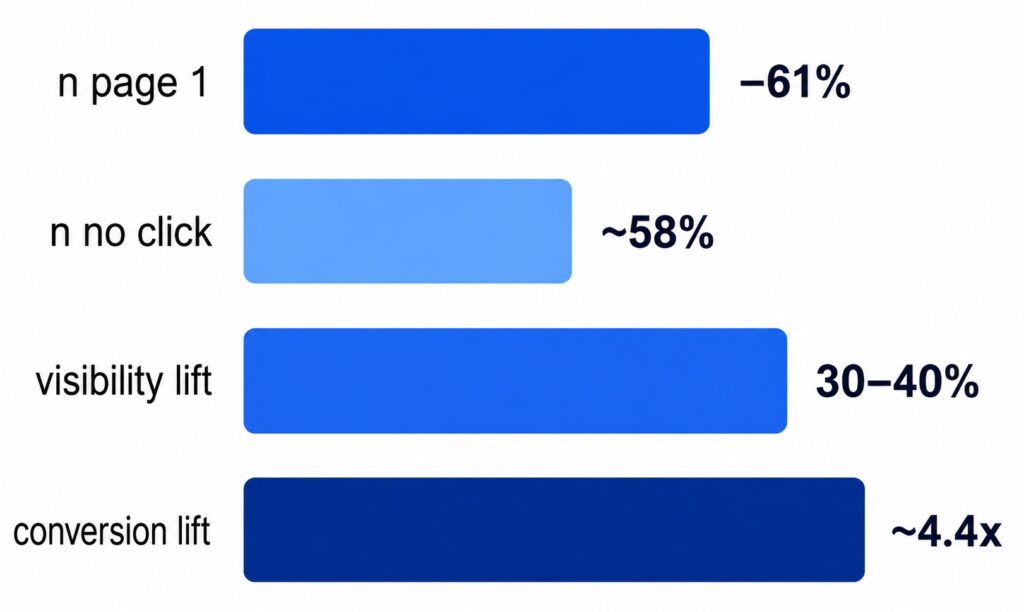
What Changes When AI Overviews Appear
The flip side is genuinely good news for smaller operators. AV’s own clients have seen what happens when content gets structured properly — our recent piece on how AI is changing SEO goes deeper into the ranking-side shift, if you want the full picture.
Generative engines reward fluency and information density over keyword density — a page that reads naturally and backs its claims with named sources will outperform a heavily optimised but generic one, almost every time.
How do you actually write for GEO?
The good news: none of this requires throwing out your content plan. It requires sharpening it. Here’s what the research consistently points to:
- Answer the question in the first 100 words.
AI tools that pull live data, like Perplexity and Google’s Overviews, weight a page’s opening content heavily. Don’t bury your answer under three paragraphs of throat-clearing.
- Back claims with real numbers and named sources.
Statistics, citations and quotations were the three strongest individual levers in the Princeton study, and combining statistics with clear, fluent writing performed best of all (Aggarwal et al., KDD 2024).
- Use question-style subheadings.
“How much does SEO cost in Auckland?” gets extracted far more easily than “Pricing Considerations.” AI engines are pattern-matching your headings against the question someone asked.
- Add an FAQ section.
Structured Q&A content remains one of the simplest ways to feed a clean, citable answer into a generative model — we cover the technical side of this in our technical SEO guide.
- Keep it fresh.
Generative engines weight recency for time-sensitive topics. A 2024 article that hasn’t been touched since will lose ground to a 2026 update covering the same question, even if the original was better written.
The good news: none of this requires throwing out your content plan. It requires sharpening it. Here’s what the research consistently points to:
- Answer the question in the first 100 words.
AI tools that pull live data, like Perplexity and Google’s Overviews, weight a page’s opening content heavily. Don’t bury your answer under three paragraphs of throat-clearing.
- Back claims with real numbers and named sources.
Statistics, citations and quotations were the three strongest individual levers in the Princeton study, and combining statistics with clear, fluent writing performed best of all (Aggarwal et al., KDD 2024).
- Use question-style subheadings.
“How much does SEO cost in Auckland?” gets extracted far more easily than “Pricing Considerations.” AI engines are pattern-matching your headings against the question someone asked.
- Add an FAQ section.
Structured Q&A content remains one of the simplest ways to feed a clean, citable answer into a generative model — we cover the technical side of this in our technical SEO guide.
- Keep it fresh.
Generative engines weight recency for time-sensitive topics. A 2024 article that hasn’t been touched since will lose ground to a 2026 update covering the same question, even if the original was better written.
Does this mean SEO is dead?
No — and anyone telling you otherwise is selling something. The vast majority of AI Overview citations still pull from pages that already rank well organically, which means your foundations (site structure, backlinks, page speed, relevance) still matter enormously. GEO doesn’t replace that work; it’s an extra layer that determines whether your already-solid page gets the actual citation or gets skipped for a competitor’s. If your backlink profile and off-page signals need attention first, our 2026 guide to off-page SEO is a good place to start.
For a small Auckland business, that’s actually an encouraging message. You don’t need a six-figure content team to win at GEO. You need writing that’s honest, specific, well-sourced and genuinely answers what your customer typed into the search bar — chat window or not.
Frequently Asked Questions
Is GEO different from SEO?
Yes. SEO optimises for ranking position in a list of links; GEO optimises for being cited directly inside an AI-generated answer. They share a foundation, but GEO adds specific requirements around statistics, sourcing and answer-first structure that SEO alone doesn’t address (Princeton/Georgia Tech/IIT Delhi, KDD 2024).
How long does it take to see GEO results?
Engines that pull live data, like Perplexity and AI Overviews, can reflect structural changes within weeks. Engines relying on training snapshots update on longer cycles, so expect a more gradual shift — typically a few months of consistent, well-sourced publishing before patterns become visible.
Do I need to rewrite my whole website for GEO?
No. Start with your highest-value pages — the ones already getting some traffic or ranking moderately well — and add clear answer-first openings, named statistics, and an FAQ block. Most of the lift comes from a handful of high-impact changes, not a total rebuild.


