
Search is changing fast, with AI taking up more space in results and organic clicks getting squeezed. The old SEO playbook doesn’t work the way it used to. To maintain visibility across Google, YouTube, and the growing landscape of AI search, having the right tools is essential.
The best SEO tools enable you to find the right opportunities, understand what is driving your visibility, outperform competitors, and build content that ranks.
This guide breaks down the top SEO tools for 2026, covering everything from all-in-one platforms to highly specialized AI workflow tools, drawing on insights from experts navigating this new era of Generative Engine Optimization (GEO) and Answer Engine Optimization (AEO).
All in One SEO Suites and Rank Trackers
These platforms offer comprehensive functionality for keyword research, competitor analysis, backlink monitoring, and site auditing.
Semrush (Best for All-in-One SEO & AI Visibility)
Semrush is recognized as the most widely used SEO tool on the market, serving as a powerful all-in-one solution for over a decade.
Key Insight | Details |
Functionality | Handles almost everything needed to run an SEO program at scale, including competitor analysis, keyword research, link building, PPC insights, and content performance. |
AI Integration | Connects traditional SEO data with AI search visibility. You can monitor how AI platforms talk about your brand across ChatGPT, Perplexity, Gemini, Claude, and Google AI Overviews. Marketers seeking both SEO and AI visibility should choose Semrush One. |
Competitor Analysis | The Domain Overview tool is excellent for tracking any website’s organic search performance over time and revealing traffic-driving keywords. |
Pricing | Starts at $139.95 per month, with a limited free plan available. |
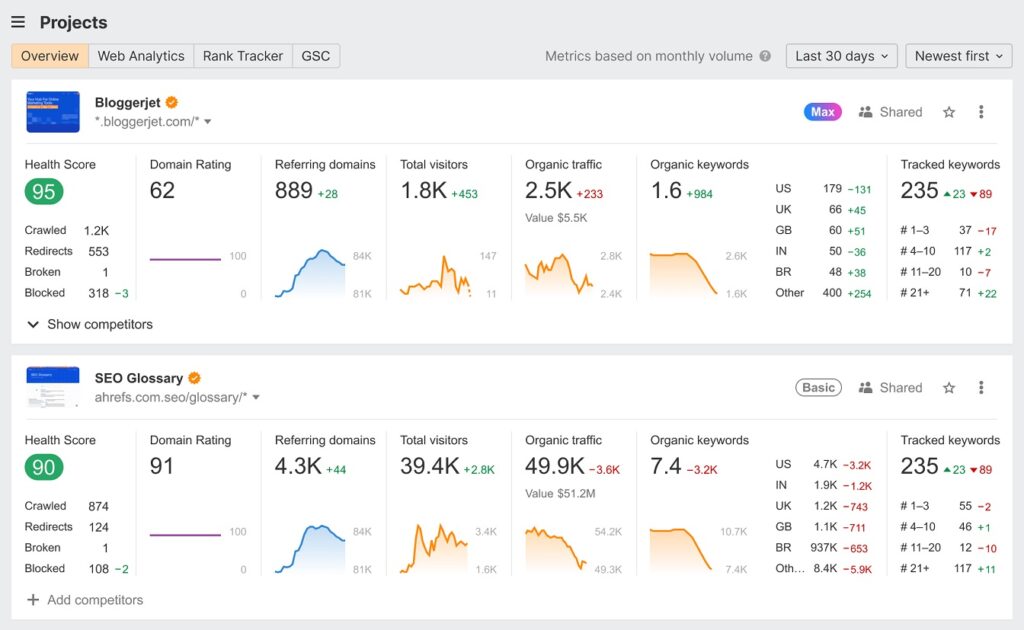
Ahrefs (Best for Competitor & Backlink Research)
Ahrefs is an SEO-first tool that is migrating toward being an overall marketing platform for all search engines and LLMs.
Key Insight | Details |
Core Strengths | Highly accurate competitor analysis without needing first-party data, as they constantly scrape the web. It is frequently used for tracking site performance and analyzing competitors via the Site Explorer feature. |
Specialized Tools | The Content Gap tool is highly effective for comparing competitors to see missed keyword opportunities. The Link Intersect tool shows which pages are linking to your competitors. |
Pricing | Pricing starts at $108 per month for the Lite plan. A secret $29/month Starter plan exists for basic usage. |
SE Ranking (Best for Agencies and Local SEO)
SE Ranking is a comprehensive, all in one platform structured to be most cost effective for teams managing multiple websites.
Key Insight | Details |
Target Audience | Specifically designed for SEO agencies, freelancers managing multiple clients, and marketing teams that need to track and report on several websites simultaneously. |
Local SEO | Includes a local marketing dashboard and multi-location rank tracking. It allows for Google Business Profile monitoring, tracking metrics like direction requests and reviews from platforms such as Yelp and Facebook. |
Pricing | Starts at $65 per month for the Essential plan. |
Content Optimization and AI Tools
These tools leverage artificial intelligence and comprehensive data to ensure content is optimized for search intent and relevance, which is crucial in the age of AI search.
Surfer (Best for AI Content Integration)
Surfer helps boost content visibility in Google, ChatGPT, and other AI search engines. It’s a key tool for creating editorial SEO content.
Key Insight | Details |
Content Editor | Scrapes top-ranking pages to generate content outlines, providing recommendations on word count, headings, and keywords to include. |
AI Features | The platform readily integrates AI, allowing users to drop in an outline, write the article, and optimize the copy using Surfer AI. |
Ease of Use | Beginner to intermediate. It easily integrates with Google Docs or WordPress. |
Clearscope (Best for Content Scoring and Content Decay)
Clearscope is a premium, AI-powered tool focused almost exclusively on content optimization.
Key Insight | Details |
Optimization | Inputting a keyword generates a full report on related keywords, providing an overall content grade and readability rating. It recommends terms based on relevance and frequency in ranking posts. |
Identifying Trends | Its keyword research tool uses a “Trending” tag to flag keywords where the latest monthly search volume is up by over 50% compared to two months prior. |
Revival Feature | The Content Decay feature shows which pages are losing traffic, flagging declines and suggesting content updates, optimization, or deeper improvement. |
ChatGPT (Best for Brainstorming and Strategy)
ChatGPT is an AI assistant that excels at brainstorming ideas and refining SEO strategies.
- Usage: It is useful for talking through complex SEO challenges, such as deciding how to structure a page or refining a broader content strategy.
- Alternative: Claude (Anthropic) is a solid alternative, recognized for its ability to retain a lot of context during long discussions. Claude is also recommended as a replacement for Grammarly, performing content proofreading to make original ideas coherent and pleasant to read.
Technical SEO and Site Health
These tools focus on the underlying technical structure of your website, ensuring search engine bots can effectively crawl and index your content.
Screaming Frog SEO Spider (Best for Technical Audits)
Screaming Frog is a super reliable desktop crawler indispensable for technical SEO audits.
- Function: It simulates how search engine bots crawl your site, identifying issues such as broken links, duplicate content, redirects, and internal linking problems.
- Integrations: It integrates with Google Analytics (GA4) and Google Search Console (GSC) to add real user data to crawl results, allowing you to quickly check technical issues against user performance.
- Target User: Designed for SEO professionals and technical specialists. The free version is limited to 500 URLs, while the paid version is $259 per year.
Google Search Console (GSC)
GSC is arguably the number one SEO tool. It is completely free and is the main source of truth for first-party data regarding SEO rankings on Google.
- Key Uses: Essential for tracking your pages and keywords, submitting sitemaps, and requesting indexing of new or updated pages. It can also be used to compare time periods to see which pages are losing traffic and need updating.
Bing Webmaster Tools
This tool is the Google Search Console for the Bing search engine.
- Value: It is often underrated, but is particularly useful for free technical audits and is important for tracking rankings in ChatGPT, as ChatGPT relies heavily on Bing searches.
Specialized and Budget-Friendly Tools
Keyword Research and Trends
Tool | Best For | Key Feature/Insight | Pricing |
Google Autocomplete | Search-intent discovery | My favorite method for finding hidden gem, long-tail keywords in real time. | Free |
Exploding Topics | Identifying emerging trends early | Tracks growth in search volume, social media conversations, and investment trends, helping you stay ahead of competitors. | Starts at $39 per month; limited free plan available |
Mangools | Beginner SEOs | A budget-friendly SEO toolkit with tools like KWFinder (for finding low-competition keywords) and a clear, intuitive interface. | Starts at $49 per month |
AnswerThePublic (ATP) | Content research on a budget | Provides unique search insights by boiling keyword research down to user search behavior and visualizing questions, prepositions, and comparisons. | Starts at $11 per month (Individual) |
Automation and Workflows
Tool | Best For | Key Feature/Insight | Ease of Use |
Gumloop | Creating SEO-automated workflows | A tool that combines Zapier and ChatGPT, allowing you to connect existing SEO tools (like Semrush data) with LLMs to build AI workflows, essentially acting as an AI SEO assistant. | Intermediate |
AirOps | AI-powered workflows | Integrates with Semrush and existing tools to automate SEO tasks, and includes an Answer Engine Visibility tool to track rankings in AI search engines. | Advanced |
The Future of SEO in 2026: Winning Visibility
In 2026, SEO is still worth it. However, success depends less on chasing hacks and more on moving faster, making smarter decisions, and focusing on what drives results.
The approach must change: the sites winning the most traffic are those that genuinely care about their audience and speak from real, lived experience, avoiding generic, outsourced content. To win in 2025, you need two elements: the ability to write content that comes from personal expertise, and knowledge of how search engines crawl, index, and rank content.
This new generation of search requires shifting your mindset from what you can get out of Google to what you can give Google, leveraging specialized tools to ensure your brand achieves visibility across traditional search and emerging AI search platforms.
FAQ
Which "All-in-One" SEO tool is right for me?
It depends on your specific focus:
- Semrush: Best if you want a complete suite that also tracks AI visibility (how you appear in ChatGPT, Gemini, etc.).
- Ahrefs: Best if your priority is deep competitor research and backlink analysis.
- SE Ranking: Best for agencies or teams managing multiple local clients who need a cost-effective solution.
How can I track my performance in AI Search (ChatGPT, Gemini, etc.)?
The guide highlights Semrush One as the primary tool for connecting traditional SEO data with AI visibility, allowing you to monitor brand mentions across LLMs. Additionally, AirOps is mentioned as an advanced workflow tool that includes an “Answer Engine Visibility” tracker.
What are the best tools for technical SEO audits?
For deep technical dives, Screaming Frog SEO Spider is the industry standard for simulating how bots crawl your site to find broken links and errors. However, Google Search Console (GSC) remains the critical “source of truth” for free, first-party data on how Google indexes your specific pages.


