
If you own a website or are looking to grow your business online in New Zealand, whether from leads or sale of products, you’ve likely heard the term SEO. It is often tossed around in marketing meetings as a “must-have,” but for many, the details remain a black box.
What exactly does it mean, and why should it be the foundation of your digital strategy?
SEO stands for Search Engine Optimization.
At its core, it is the practice of improving your website’s content, structure, and visibility to rank higher on search engines like Google. But more eloquently, SEO is both the art and the science of improving a website so it becomes as visible as possible when people search for relevant topics or search queries that are capable of converting into sales for your business.
The primary goal isn’t just to “trick” the algorithm. The goal is to rank on the first page of search engine results pages (SERPs) for keywords relevant to your target audience.
Why? because visibility drives qualified traffic. Ultimately, SEO helps search engines understand your content and connect it with users who are actively looking for a solution.
In this guide, we break down exactly how this process works, from the technical crawling of your site to the creative strategy of content, and how you can use it to drive real revenue.
Connection between GEO and SEO
It’s impossible to discuss SEO without GEOin 2025. Search Engine Optimisation (SEO) and Generative Engine Optimisation (GEO) are two complementary strategies New Zealand businesses must now consider. SEO improves visibility in traditional search engines like Google, while GEO ensures your brand is discoverable in LLM platforms that generate direct answers. Together, they help service providers and ecommerce businesses remain competitive in both search results and AI recommendations.
However, the rise of zero-click searches, where users get answers directly on search pages without visiting a site, has changed user behavior forever. Featured snippets, local packs, and AI overviews mean businesses can gain visibility without clicks, but this also reduces direct traffic.

How Does SEO Work? Crawling, Indexing, and Ranking
Many business owners treat Google like a black box, you put money or content in, and hope customers come out. But SEO isn’t magic; it is a logical, methodical, evidence based and a mechanical process.
SEO works by helping search engines understand your website content and ensuring it appears for relevant searches. To win at SEO, you must optimise for the three core stages of the search engine’s job:
Crawling (The Discovery Phase)
Before you can rank, you must be found. Search engines use automated bots known as “crawlers” or “spiders” to discover pages across the web.
They do this by following links from one page to another and by reading sitemaps (a file that lists all your website’s pages).
Read more about what crawl budget is and why its important google.
Indexing (The Filing Phase)
Once a crawler finds your page, it doesn’t immediately show up in search results. It must first be indexed. During this stage, the search engine analyses your page to understand what it is about. It reads your content, your images, and your metadata (code that describes your page).
It then stores this information in the Index – a massive, world-spanning database of web content.
How to improve this: Only indexed pages are eligible to appear in search results. To help Google file you correctly, you must ensure your pages have clear, keyword-rich headings, utilize proper meta tags, and avoid duplicate content that confuses the database.
Ranking (The Decision Phase)
This is the final and most complex stage. When a user types a query into Google, the search engine searches its Index to find the best matches.
Ranking is where complex algorithms examine hundreds of different signals to determine the order in which pages appear.
Why SEO Is a Critical Marketing Channel
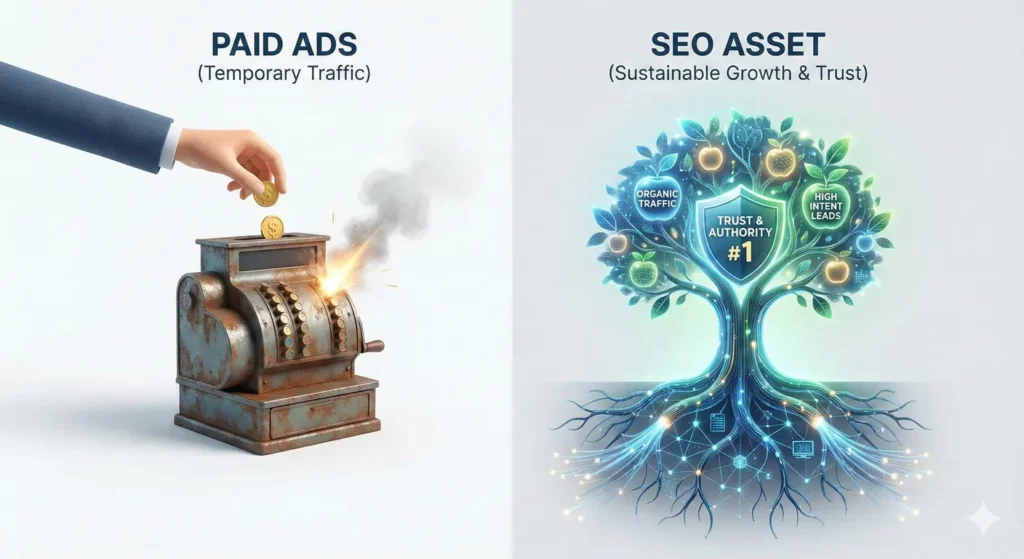
Startups often ask, “Why invest in SEO when I can just buy ads?” The answer lies in sustainability and user intent. SEO is inarguably considered a critical marketing channel because it offers high impact where paid channels often fall short, and one the most (if not, the most) effective trust building tools for brands. Brands that earn high levels of trust not only attract new customers more easily but also strengthen loyalty and expand their market share. This greatly reduces Customer Acquisition Cost.
Here is why SEO drives the bottom line for New Zealand businesses:
- It Drives Massive Traffic: Organic search delivers 53% of all website traffic. With over 8.5 billion searches happening every day on Google (which owns 91% of the global market), showing up here is not optional—it is essential.
- High Intent Leads: SEO is an intent-driven strategy. Unlike social media, where you interrupt a user’s scrolling, SEO connects you with users who are actively and consciously seeking a solution. These users are statistically highly likely to convert.
- Sustainable Results: Paid campaigns stop the moment the budget runs out. Good SEO work creates an asset that continues to drive traffic over time, compounding your return on investment.
- Trust and Authority: A website that ranks well is generally regarded by consumers as a market leader. Ranking #1 signals that you are the authority in your industry.
The Three Pillars of SEO Success
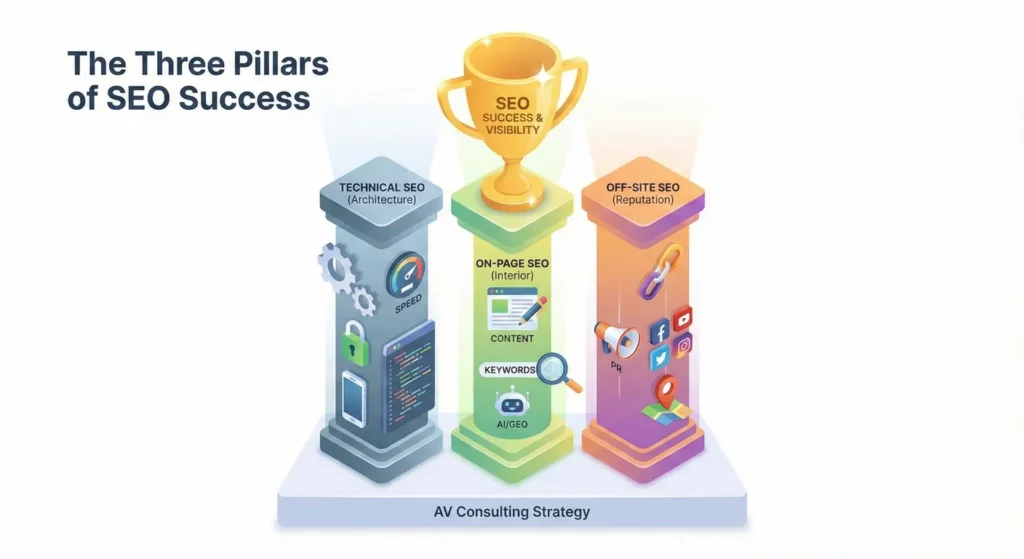
To achieve this visibility, you cannot simply “sprinkle keywords” on a page. Algorithms are far too smart for that now. At AV Consulting, we execute SEO across three distinct pillars. Think of this as the Architecture (Technical), the Interior (On-Page), and the Reputation (Off-Site) of your digital storefront or office.
Technical SEO
Technical SEO involves optimising the underlying structure of your website. It focuses on building an architecture that search engines can easily crawl and index. If your technical foundation is weak, your content will never be seen.
Key activities include:
- Site Architecture: Ensuring clear URL structures, logical navigation, and internal linking so bots don’t get stuck.
- Core Web Vitals (UX): Google measures your site’s “health” through speed and stability. We optimize for:
- Loading Performance (Largest Contentful Paint).
- Interactivity (First Input Delay).
- Visual Stability (Cumulative Layout Shift).
- Mobile-Friendliness: With the majority of traffic coming from phones, responsive design is mandatory.
- Security (HTTPS): Protecting user data builds trust and is a confirmed ranking signal.
- Structured Data (Schema): Adding specific code to help search engines understand your content context (e.g., telling Google that a string of numbers is a “Phone Number” or a “Price”).
Technical SEO is a core part of modern optimization. Learn how backend website infrastructure affects rankings in our complete Technical SEO guide.
On-Page SEO
On-page SEO is the process of optimising the content users actually see. The primary goal is to publish helpful, high-quality, and unique content that satisfies the user’s needs.
Key elements to optimize include:
- Content Quality: Creating original, well-researched content structured with clear subheadings and appropriate reading levels.
- Keyword Optimisation: Incorporating relevant keywords naturally into titles, headers (H1-H6), and body content to match search intent—without “stuffing.”
- HTML Elements: Writing compelling Title Tags and Meta Descriptions to improve click-through rates.
- Generative Engine Optimization (GEO): The Future of SEO. This emerging specialty focuses on optimizing content for visibility in AI-driven answer engines, such as Google’s AI Overviews and ChatGPT. We structure data so AI models can easily cite your business as the answer.
Off-Site SEO
Off-site SEO involves activities done outside your website to build authority, recognition, and credibility. This tells Google that other people trust you.
Key activities include:
- Link Building: The process of acquiring backlinks (links pointing to your website) from relevant, trusted websites. In SEO, link quality generally beats link quantity. One link from a major NZ news site is worth 100 links from low-quality directories.
- Listing Management: For local businesses, claiming and verifying your Google Business Profile is the single most impactful off-site action.
- Brand Building & PR: Using public relations to earn editorial mentions and links.
- Social Media Marketing: While social shares aren’t a direct ranking factor, they increase visibility and traffic, which contributes to your overall authority signals.
SEO in the Digital Marketing Landscape (SEO vs. SEM vs. PPC)
In digital marketing, acronyms are often used interchangeably, leading to confusion. To make smart budget decisions, it helps to understand how these channels relate to one another.
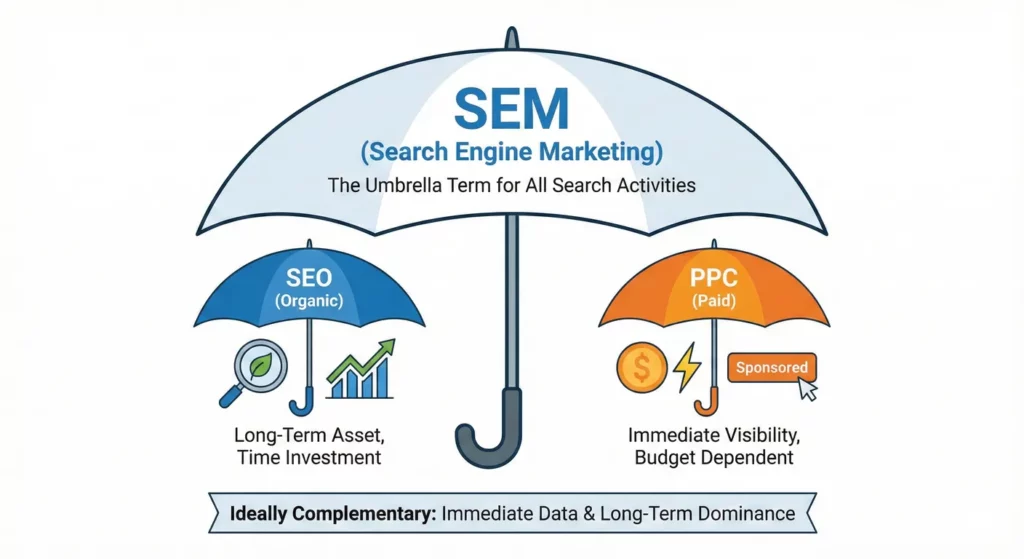
SEM (Search Engine Marketing) is the umbrella term. It represents the combination of all activities, both organic and paid, that drive traffic via search engines.
Under this umbrella, we have two distinct approaches:
For more Information, you can read PPC vs SEO blog.
SEO (Search Engine Optimization)
The Focus: Driving clicks from organic (unpaid) results.
The Cost: While you don’t pay Google for the click itself, the process requires an investment of time, content creation, and technical expertise.
The Value: It builds a long-term asset. Once you rank, you can generate traffic for years without continuous spending.
PPC (Pay-Per-Click)
The Focus: Driving clicks from paid listings (usually labeled as “Sponsored”).
The Cost: Advertisers bid on specific keywords. You are charged a fee every single time a user clicks your ad.
The Value: Immediate visibility. You can appear at the top of page 1 instantly, but the traffic stops the moment your budget runs out.
Ideally, SEO and PPC are complementary. Click Through Rate is 90% or higher when your site link appears in both the sponsored and organic sections of SERPs when both links are closely positioned – users naturally place greater trust in links they encounter multiple times. If your budget allows, utilising both gives you immediate data (via PPC) while building long-term dominance (via SEO).
The Ongoing Evolution of SEO in 2026
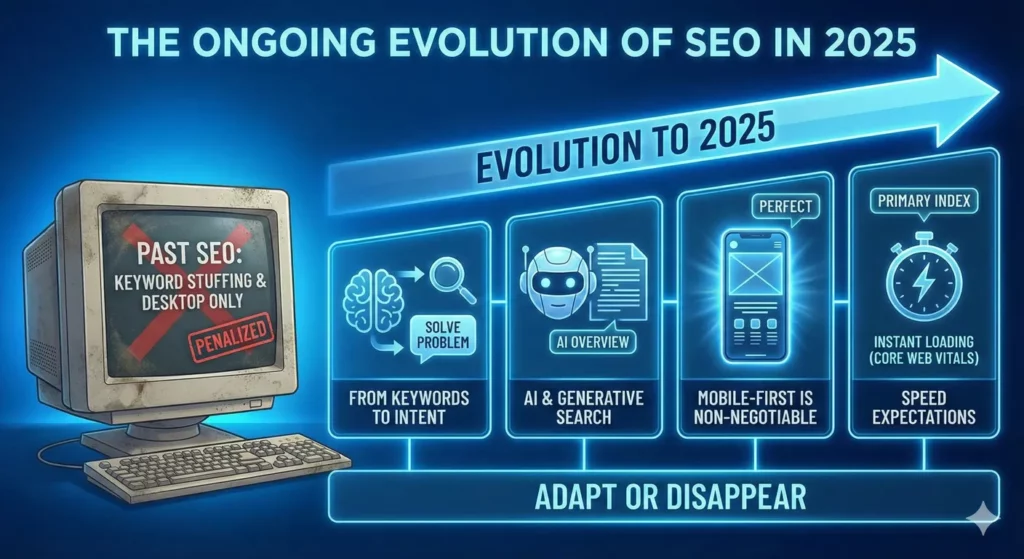
SEO is an ongoing process that never ends. Why? Because technology, user behavior, and your competitors are constantly evolving. Strategies that worked five years ago (like repeating a keyword 50 times) will now get your site penalized.
In the context of 2026, here is where the industry is moving:
- From Keywords to Intent: The focus is shifting from raw keywords to search intent. Search engines now understand context. They don’t just want to match a word; they want to solve the user’s problem.
- AI and Generative Search: Search results are increasingly influenced by AI-driven features, such as AI Overviews. Your content now needs to be structured clearly enough to be “read” and summarized by these AI models.
- Mobile-First is Non-Negotiable: Google now favors a site’s mobile performance as its lead indicator. With over 63% of searches occurring on mobile phones, a site that doesn’t perform well on a smartphone effectively doesn’t exist in Google’s eyes.
- Speed Expectations: User patience is at an all-time low. Speed and Core Web Vitals are paramount, users expect near-instant loading times.
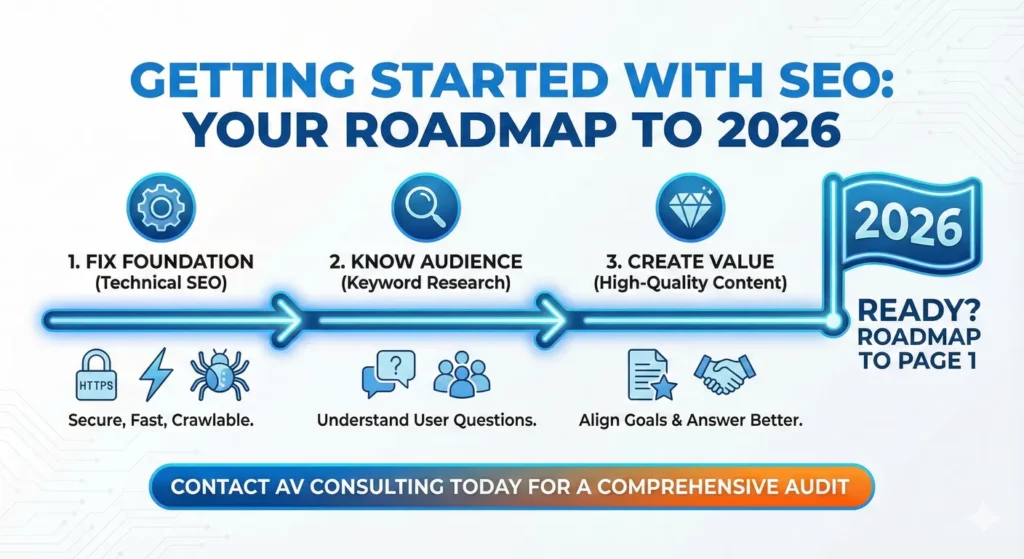
Getting Started with SEO
Ready to stop being invisible and start capturing the market?
To start with SEO, you need to prioritise the order of operations. At AV Consulting, we recommend beginning with the basics:
- Fix the Foundation: Focus on Technical SEO first. Ensure your site is secure (HTTPS), fast, and crawlable. If the foundation is cracked, nothing else matters.
- Know Your Audience: Conduct Keyword Research to understand exactly what your customers are asking.
- Create Value: Produce high-quality content that aligns with those business goals and answers user questions better than anyone else.
Remember, SEO is not a quick fix, it is the essential foundation for long-term growth, brand loyalty, and revenue.
Is your website ready for 2026? Don’t guess about your visibility. Contact AV Consulting today for a comprehensive audit of your technical, content, and authority profile. Let’s build your roadmap to Page 1.
Also you can see our plan in seo services page.

Turn SEO issues into real growth
- Our SEO specialists review your site, identify what’s holding it back, and show you exactly how to fix it
FAQ
How long does it take for SEO to start working?
Generally, it takes 4 to 12 months to see significant results. While you might see some minor improvements earlier, SEO is a long-term investment. The timeline depends on your website’s history, the level of competition in your niche, and how consistently you publish high-quality content.
Can I do SEO on my own?
Yes, you can. Many people learn the basics of SEO through online resources and successfully optimize their own sites. However, as your business grows or enters a highly competitive market, the technical requirements and the time needed for content and backlink building often require hiring a specialist or an agency.
What is the difference between SEO and SEM (Paid Search)?
The main difference is cost and speed.
SEO (Search Engine Optimization) focuses on getting “organic” (free) traffic. It takes longer to see results but provides a higher long-term return on investment.
SEM (Search Engine Marketing) usually refers to paid ads like Google Ads. It provides instant visibility and traffic, but you have to pay for every click, and the traffic stops as soon as you stop paying.


