
Business is now more competitive than ever and even more so with online marketing with visibility being everything. When it comes to driving traffic from search engines like Google and Bing, two strategies drive the conversation: Search Engine Optimisation (SEO) and Pay-Per-Click (PPC) advertising.
While they share the same end goal of getting potential customers to your website they take fundamentally different yet complementive approaches to get there. One relies on building organic authority over time, while the other focuses on paid, immediate top position placement. Deciding which strategy (or which combination) is best for your business depends heavily on your budget, competitors, brand maturity, timeline, and specific marketing objectives.
What exactly are SEO and PPC?
Both SEO and PPC are fundamental tools for improving your online visibility via search engines, but they rely on completely different principles to drive traffic.
Search Engine Optimization (SEO)
SEO is the process of optimizing your website to rank higher in the organic (unpaid) search results of engines like Google and Bing. The goal is to prove to search engines that your content is the best answer to a user’s query or keyword.
A successful SEO strategy relies on three main pillars:
- Content Optimization: Creating high-quality, relevant content (both in landing pages and blogs or articles) that naturally utilizes the right keywords to answer user questions.
- Technical SEO: Ensuring your website is healthy “under the hood.” This includes fast load speeds, mobile-friendliness, and a clean site structure that search bots can easily crawl.
- Authority Building (Off-Page SEO): This is also called earned media. Earning trust through high-quality backlinks from other reputable websites, which signals to Google that your site is a credible source.
For more information about Seo, please write what is Seo.
Pay-Per-Click (PPC) Advertising
PPC is a paid advertising model where you bid to have your ads displayed at the top of search results or across a display network. The defining feature is the payment structure: you only pay a fee when a user actually clicks on your ad.
Essential aspects of a PPC campaign include:
- Keyword Bidding: Competing in an auction system to target specific search terms. You decide the maximum amount you are willing to pay for a click.
- Ad Creation: Writing compelling headlines and ad copy that encourage users to click through.
- Landing Page Optimisation: Ensuring the page users arrive at is relevant to the ad and their search query. The page needs to be optimised to convert users into a lead or customer.
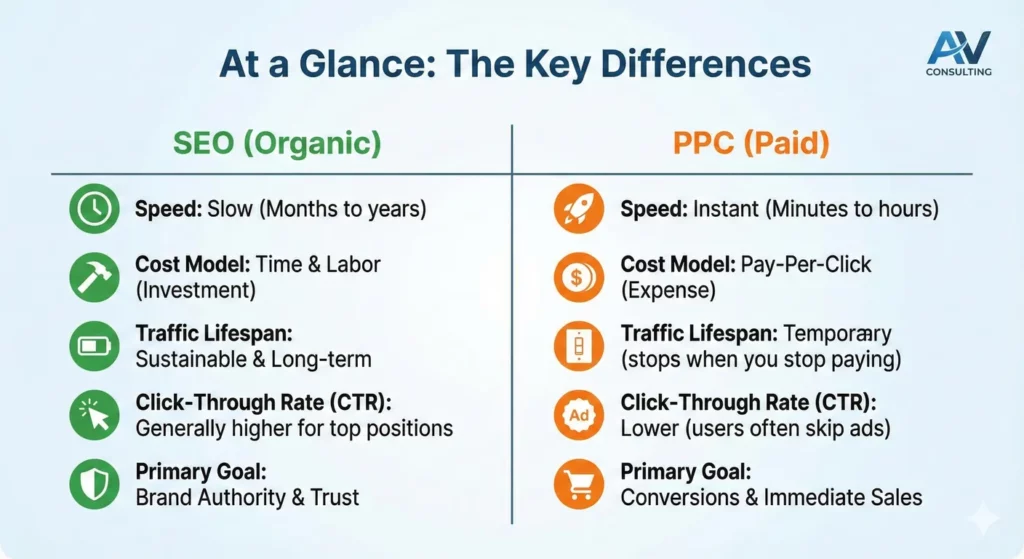
At a Glance: The Key Differences
While SEO and PPC both aim to drive traffic, the mechanics behind them create vastly different experiences for a business owner. Understanding these distinctions is critical for budget allocation and managing expectations.
Speed of Results: Agility vs. Momentum
PPC (Fast & Immediate): PPC offers instant gratification. Once your campaign is set up and approved, your ads can appear in search results within minutes. This makes it ideal for time-sensitive promotions, product launches, or entering a market where you have no existing footprint.
SEO (Gradual & Compounding): SEO is a long game. It takes time for search engine bots to crawl your content, index and trust it, and for your site to build enough authority to outrank competitors. You typically won’t see significant ROI for 3 to 6 months, but the results compound over time.
Cost Structure: Investment vs. Expense
PPC (Paid Expense): The cost is direct and scalable. You pay a fee every time a user clicks (Cost Per Click). If you want more traffic, you generally have to increase your budget. However, you have total control over exactly how much you spend per day.
SEO (Resource Investment): While you don’t pay Google for organic clicks, SEO is not “free.” The cost comes in the form hiring content writers, SEO specialists, and developers. However, once you rank, the traffic is free, meaning your cost-per-acquisition (CPA) decreases over time as traffic volume grows.
Placement & Visibility
PPC: depending on your goals (maximum conversion or maximum clicks) Ads appear at the absolute top of the Search Engine Results Page (SERP), above the organic listings. They are marked with a “Sponsored” or “Ad” tag. This prime real estate guarantees visibility, even if the user doesn’t scroll down.
SEO: Organic results appear below the ads and local map packs. While they are lower on the page, many users subconsciously trust organic results more than ads because it does not have the “sponsored” icon. They view organic results as more authentic endorsements by the search engine.
Sustainability & Longevity
PPC: This is a temporary traffic source. The moment you stop paying or your budget runs out for the day, your visibility disappears instantly. It does not build long-term equity for your domain.
SEO: This builds a sustainable asset. If you rank #1 for a valuable or transactional keyword, you can maintain that traffic for years with only minor maintenance updates. Even if you pause your SEO efforts for a month, your traffic won’t drop to zero overnight.
Targeting Precision
PPC: Offers granular targeting capabilities. Beyond just keywords, you can target users based on demographics, location, time of day, and even past behaviors (retargeting). You can “laser focus” on your ideal customer.
SEO: Relies almost entirely on user intent and keywords. You cannot strictly control who sees your content, only what search terms trigger it. You are casting a wider net to catch users looking for information.
Feature | SEO (Organic) | PPC (Paid) |
Speed | Slow (Months to years) | Instant (Minutes to hours) |
Cost Model | Time & Labor (Investment) | Pay-Per-Click (Expense) |
Traffic Lifespan | Sustainable & Long-term | Temporary (stops when you stop paying) |
Click-Through Rate (CTR) | Generally higher for top positions | Lower (users often skip ads) |
Primary Goal | Brand Authority & Trust | Conversions & Immediate Sales |
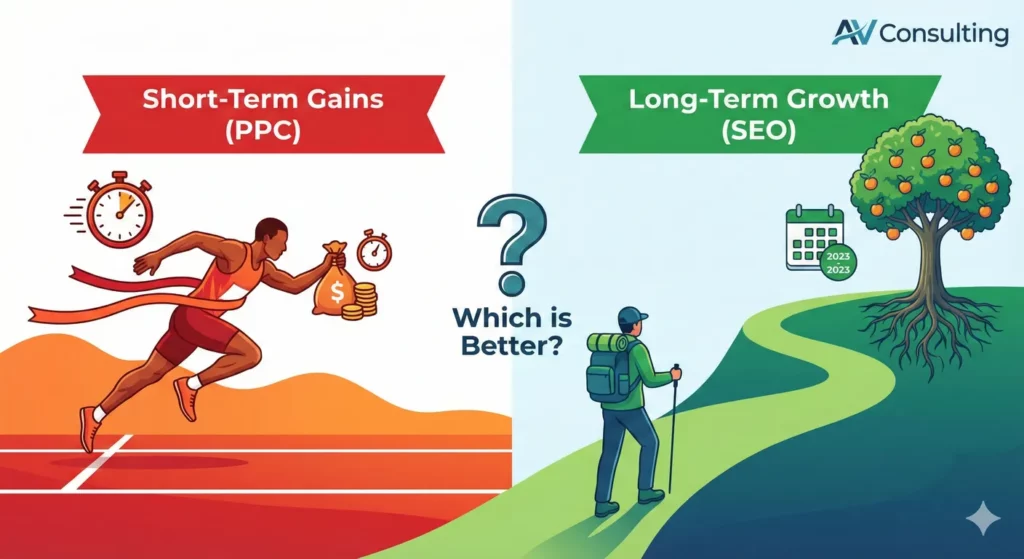
Short-Term Gains vs. Long-Term Growth: Which is Better?
The question of whether SEO or PPC is “better” is misleading. It’s not about which tool is superior; it’s about which one aligns with your current business timeline and financial goals.
To make the right choice, you need to look at your objectives: Do you need sales today, or are you already drawing sales and want to build a brand for tomorrow to decrease your customer acquisition cost?
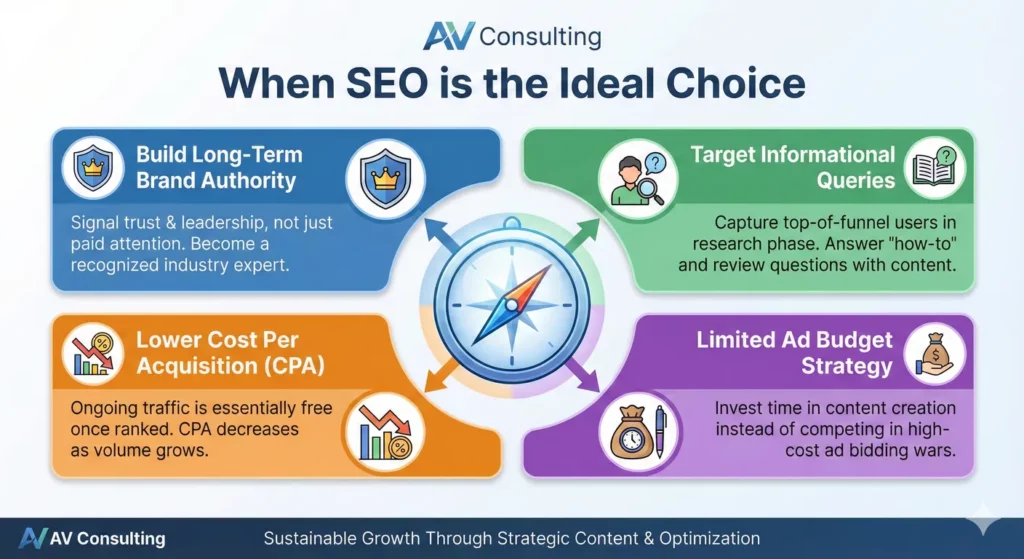
When SEO is the Ideal Choice
SEO is the backbone of a sustainable digital presence. This is because in order for it to succeed, a lot of other enterprise areas need to improve as well including: targeting, referral traffic from social media, a great product or search explained well on your website and so on. It requires patience, but the return on investment (ROI) can be massive over time because you aren’t paying for every single visitor and the brand authority you command would have risen significantly.
Choose SEO if:
- You want to build long-term brand authority. Ranking organically signals to users that you are a trusted leader in your industry, not just a company paying for attention and thereby decreasing Customer Acquisition Cos (CoC)..
- You are targeting informational queries. Many users are in the research phase (Top of Funnel) and aren’t ready to buy yet. They are looking for “how-to” guides or reviews. SEO is perfect for capturing this audience through blog content. GEO provides many of these answers now without requiring a click but it runs on the same fundamentals which leads authoritative sites to be cited and linked in LLM answers like Chat and Gemini.
- You want to lower your Cost Per Acquisition (CPA). While SEO costs money to implement initially, once you rank, the ongoing traffic is essentially free. This drives down your average cost per lead over time as your organic ranking is placed closer to your sponsored PPC ads. The more users see a link, the more they trust it – this basic human psychology.
- You have a limited ad budget. If you cannot afford to compete in high-cost bidding wars, investing time in content creation is a smarter, safer route.
Ready to stop paying for every single click? Building a high-traffic website takes the right strategy. Climb the rankings with us and secure your spot at the top of Google.
Stop Paying for Every Single Click
If you are tired of watching your marketing budget vanish the moment a campaign ends, it is time to pivot. Let us help you build a self-sustaining traffic engine that works for you 24/7—for free. Discover how our SEO Services can lower your customer acquisition costs and drive organic growth.
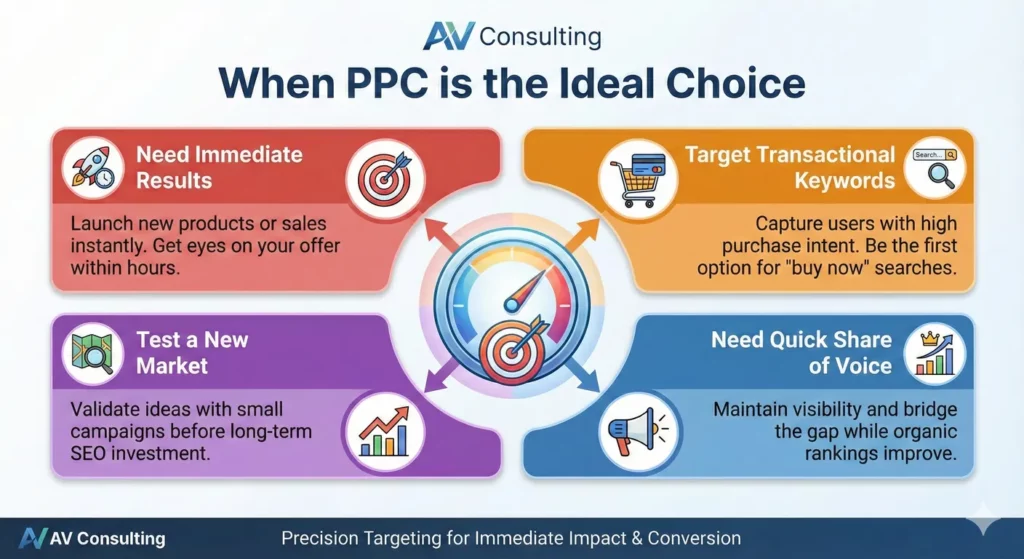
When PPC is the Ideal Choice
PPC is a precision tool designed for speed and conversion. It allows you to bypass the waiting period of SEO and get straight to the customers.
Choose PPC if:
- You need immediate results. If you are launching a new product, running a holiday sale, or need to clear inventory quickly, PPC can get eyes on your offer within hours.
- You are targeting “transactional” keywords. When users search for “buy ergonomic office chair” or “emergency plumber near me,” they have their credit cards ready. PPC ensures you are the first thing they see at that critical moment.
- You want to test a new market. Before spending months trying to rank for a keyword via SEO, you can run a small PPC campaign to see if that keyword actually converts. It’s a great way to validate your ideas.
- You need Share of Voice in a niche quickly. If your organic rankings are poor, PPC acts as a bridge, keeping your business visible while your SEO strategy works in the background.
Need traffic and sales right now? Don’t burn your budget on guesswork. We create laser-focused ad campaigns that maximise your ROI from day one.
Stop Wasting Budget on the Wrong Clicks
PPC is powerful, but only if you target the right people at the right time. At AV Consulting, we create laser-focused ad campaigns that bypass the browsers and target the buyers. Explore our PPC Management Services and let’s turn your ad spend into profit.
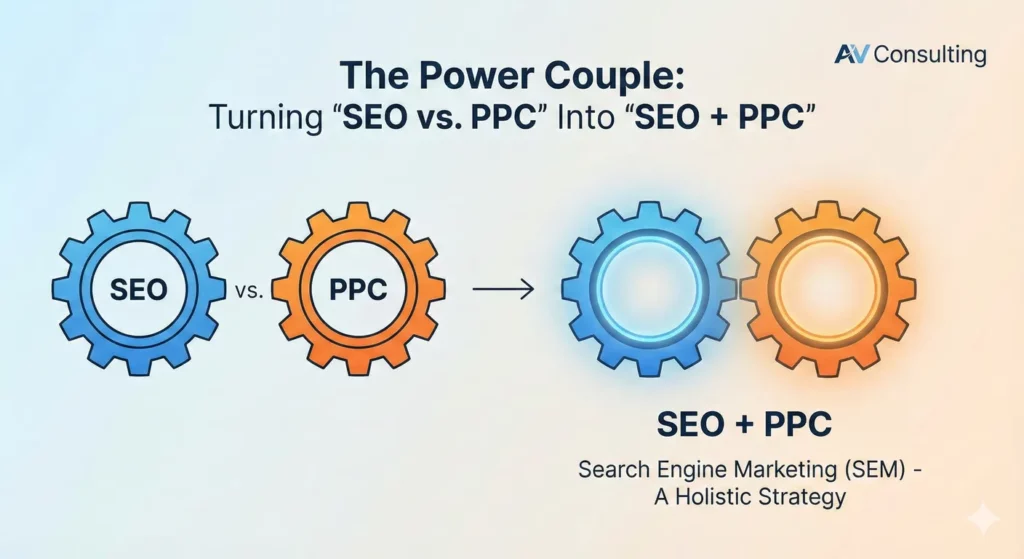
The Power Couple: Turning "SEO vs. PPC" Into "SEO + PPC"
While they play separate roles, SEO and PPC often work best together. When combined, they form a holistic strategy known as Search Engine Marketing (SEM). Instead of viewing them as competitors, think of them as teammates passing the ball to score the same goal.
Use PPC to "Audition" Your Keywords
Before you spend months creating content and building links for a specific keyword, test it with a small PPC campaign.
- The Strategy: Run ads for the keyword you want to rank for.
- The Benefit: If the keyword drives sales via ads, you know it’s worth investing in for SEO. If it gets clicks but no sales, you just saved yourself months of wasted SEO effort.
Dominate the Digital Real Estate (SERPs)
Why settle for one spot on Google when you can have two?
- The Strategy: Bid on keywords where you already rank #1 organically.
- The Benefit: When a user sees your brand in the paid ad slot and the top organic slot, it creates a “dominance effect.” It signals market leadership and significantly increases the likelihood that the user will click on one of your links rather than a competitor’s.
Retargeting: The Ultimate Safety Net
Most users won’t buy on their first visit. This is where the integration of SEO and PPC shines brightest.
- The Strategy: A user finds your educational blog post via organic search (SEO) but leaves without buying. Later, you show them a display ad (PPC) on Facebook or another website reminding them of your product.
- The Benefit: You used “free” SEO traffic to find the lead, and “paid” PPC to close the deal. This is often much cheaper than using PPC for the initial and primary acquisition.
Fill the Gaps
Sometimes, specific keywords are just too competitive to rank for organically right away, or the search results are dominated by massive brands like Amazon.
- The Strategy: Use PPC to target these “impossible” keywords while focusing your SEO efforts on more accessible, long-tail keywords.
- The Benefit: This ensures you are visible everywhere, without breaking the bank or fighting losing battles.
The Final Verdict: Renting vs. Owning
If you need a simple way to visualize the difference for your business strategy, remember this analogy:
- PPC is like renting an apartment. You get immediate access to a prime location. It is fast, effective, and low maintenance. But the moment you stop paying rent, you are evicted, and your visibility vanishes instantly.
- SEO is like building your own house. It takes time to lay the foundation and build the structure. It requires significant effort and “sweat equity” upfront. But once it is built, you own the asset. It provides shelter, value, and equity for years to come, without a monthly rent payment.
The smartest investors do both: they rent while they build.
Frequently Asked Questions
Does running PPC ads help my organic SEO rankings?
Directly? No. Paying Google for ads does not give you “special treatment” in the organic search results. However, indirectly, they can help. PPC increases your overall brand visibility and traffic, which can lead to more people searching for your brand name organically, a signal that search engines love.
If I have a limited budget, should I start with SEO or PPC?
If you need cash flow immediately to keep the lights on, start with a small, highly targeted PPC campaign. If you can afford to wait a few months and want to minimize costs in the long run, invest your time in SEO. For most small businesses, the “sweet spot” is dedicating 80% of the budget to SEO (content) and 20% to PPC (retargeting).
How long does it actually take to see results from SEO?
SEO is not a switch you flip; it’s a reputation you build. Generally, you can expect to see initial movement in 3–6 months. However, significant traffic and ROI usually kick in around the 6–12 month mark. The timeline depends heavily on how competitive your industry is and how consistent your content strategy is.
Can I stop doing SEO once I rank #1?
No. SEO is like going to the gym, if you stop, you eventually lose your “muscle.” Competitors are always trying to outrank you, and Google is constantly updating its algorithm. To maintain your top spot, you need to regularly update old content and ensure your website remains technically healthy.


