
Imagine a potential customer standing two streets away from your business, searching on their phone for exactly what you offer. Do they see you, or do they see your competitor?
For businesses in New Zealand whether you are a cafe in Ponsonby, a plumber in Christchurch, or a boutique in Wellington appearing in those specific geographic search results is the difference between a quiet day and a fully booked schedule. This is where Local SEO comes in.
At AV Consulting, we specialize in helping Kiwi businesses dominate their local market. But what exactly is Local SEO, and why is it distinct from the traditional SEO strategies you might already know?
What is Local SEO?
Local SEO (Search Engine Optimisation) is the strategic process of optimizing your business’s visibility in unpaid, location based search results on platforms like Google Search and Google Maps.
In simpler terms, think of Local SEO as your “virtual business card.” It ensures that when someone searches for products or services in a specific region, city, or district, your business appears front and center. It makes you easier to find and more attractive to people nearby who are ready to buy.

Why Is It Important? (The Numbers Don’t Lie)
If you think local search is just a small part of the digital landscape, think again. The statistics paint a clear picture of user behavior:
- 46% of all Google searches have “local intent” (people looking for something nearby).
- 76% of people who search for something nearby on a mobile device visit a related business within a single day.
Without a Local SEO strategy, you risk losing visibility to competitors who have better maintained profiles and more reviews. This leads directly to a loss in foot traffic, phone calls, and sales.
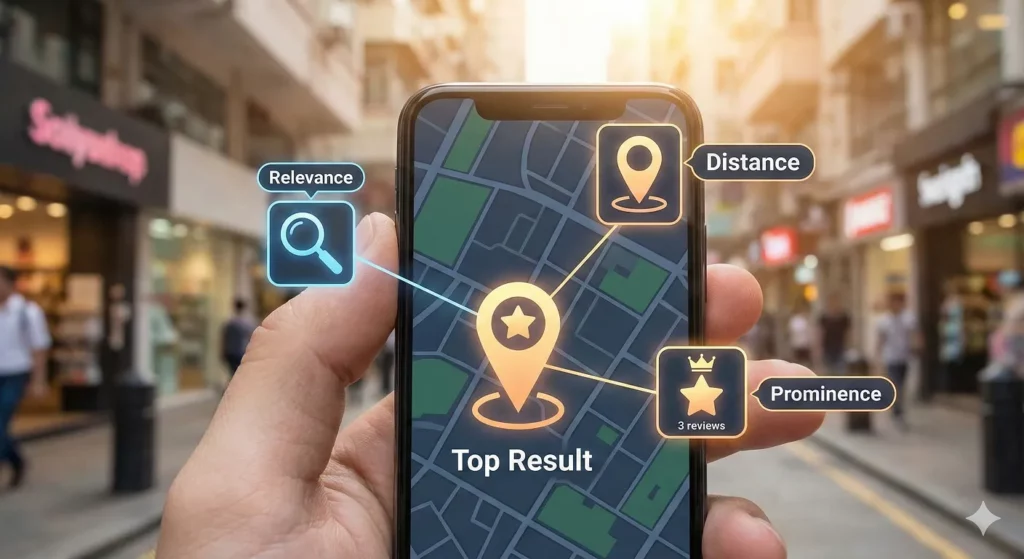
How Google’s Local Algorithm Works
Google wants to provide the best match for a user’s search. According to industry insights, the local algorithm relies on three primary pillars to determine where you rank:
Relevance: How well your business profile matches what the user is searching for.
Distance (Proximity): How far the potential customer is from your location at the exact moment of their search.
Prominence (Notability): How well-known and trustworthy your business is, based on reviews, links, and directory mentions.
For a deeper, practical walkthrough, see how you can improve your Local SEO with proven optimization methods.
Key Strategies to Improve Your Local Visibility
To get your business into the “Local Pack” (that coveted box with the map and top 3 business listings), several critical tasks are required:
- Google Business Profile (GBP) Optimisation: This is your foundation. Maintaining an active profile with updated opening hours, photos, and regular posts is essential.
- Local Keyword Research: We identify terms locals actually use, such as “Mexican restaurants near me” or “Dentist in Auckland.”
- Review Management: Actively encouraging and responding to customer reviews provides social proof as a key ranking signal.
- Local Backlinks: Gaining links from other trusted NZ websites, such as local newspapers or business blogs, validates your relevance to the area.
- On-Page Content: Creating location-specific pages on your website and using local business schema.
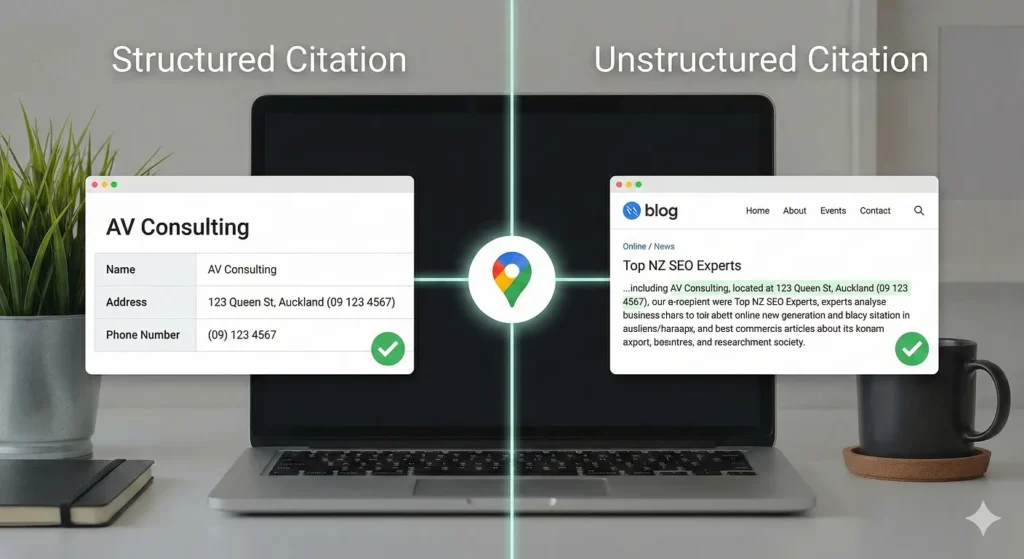
The Power of Citations: Structured vs. Unstructured
One of the most technical aspects of Local SEO is managing Citations. A citation is any online mention of your business’s NAP (Name, Address, and Phone Number). Consistency here is key if Google sees conflicting phone numbers or addresses, it loses trust in your data.
There are two types of citations we focus on:
Structured Citations
These are formal listings found in online directories (like Yellow.co.nz, Yelp, or Apple Maps). They display your NAP details in a standardized format. Because they are predictable, they are easy for search engines to crawl and use to confirm your legitimacy.
Unstructured Citations
These are mentions of your business on websites that aren’t dedicated directories, such as blogs, news sites, or online magazines. For example, if a local lifestyle blog mentions your restaurant in an article about “Top Eats in Wellington,” that is an unstructured citation. These are powerful because they act as a validation of your local relevance from trusted community sources.
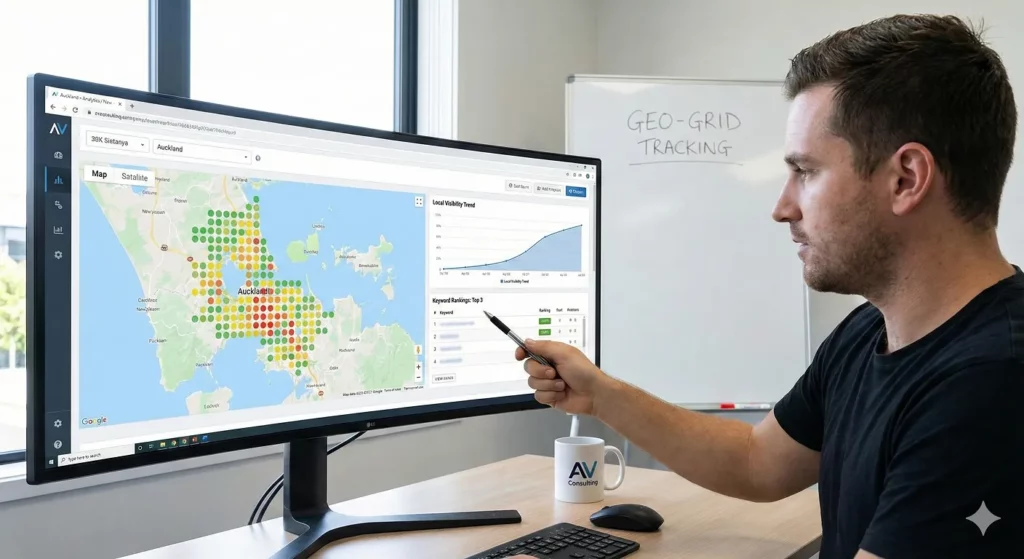
How We Monitor Your Success
At AV Consulting, we don’t guess; we track. Using advanced tools like Semrush’s Position Tracking and BrightLocal, we can monitor your rankings at a granular level.
Unlike traditional SEO which looks at national rankings, we use Geo Grid tracking. This allows us to see how you rank down to specific postcodes or neighborhoods. We can visualize exactly where you are winning against competitors and where we need to improve your “Prominence.”
Ready to Get Found Locally?
While traditional SEO helps you rank globally, Local SEO is designed for businesses that rely on customers walking through the door or serving a specific area. You can even rank for local searches without a website, provided your Google Business Profile is optimized (though having a website helps immensely!).
Don’t let your competitors capture the 76% of customers looking for services right now.
Contact AV Consulting today. Let’s put your business on the map literally.
Frequently Asked Questions
What is the difference between Traditional SEO and Local SEO?
While traditional SEO focuses on improving your website’s visibility on a national or global scale, Local SEO is specifically designed for businesses that serve a physical location or geographic area. Traditional SEO targets general keywords (e.g., “best running shoes”), whereas Local SEO targets location-specific intent (e.g., “running shoe store in Christchurch”) to drive foot traffic and local leads.
Can I rank in local search results if I don’t have a website?
Yes, it is technically possible. Google allows businesses to rank in the “Local Pack” (the map results) purely by having a claimed and optimized Google Business Profile. However, having a website is highly recommended as it provides more content for Google to index, allows for better optimization, and builds greater trust with potential customers who want to learn more about you.
Why is it so important to have consistent business information (NAP) online?
Consistency is critical for building trust with Google. If your Name, Address, and Phone number (NAP) vary across different websites for example, listing “Road” on one site and “Rd” on another, or having an old phone number listed Google becomes unsure which information is correct. This confusion can lower your “trust score,” making Google less likely to show your business in top search results.


